Event report • Events
Executive Club: Highlights from the 4th Edition
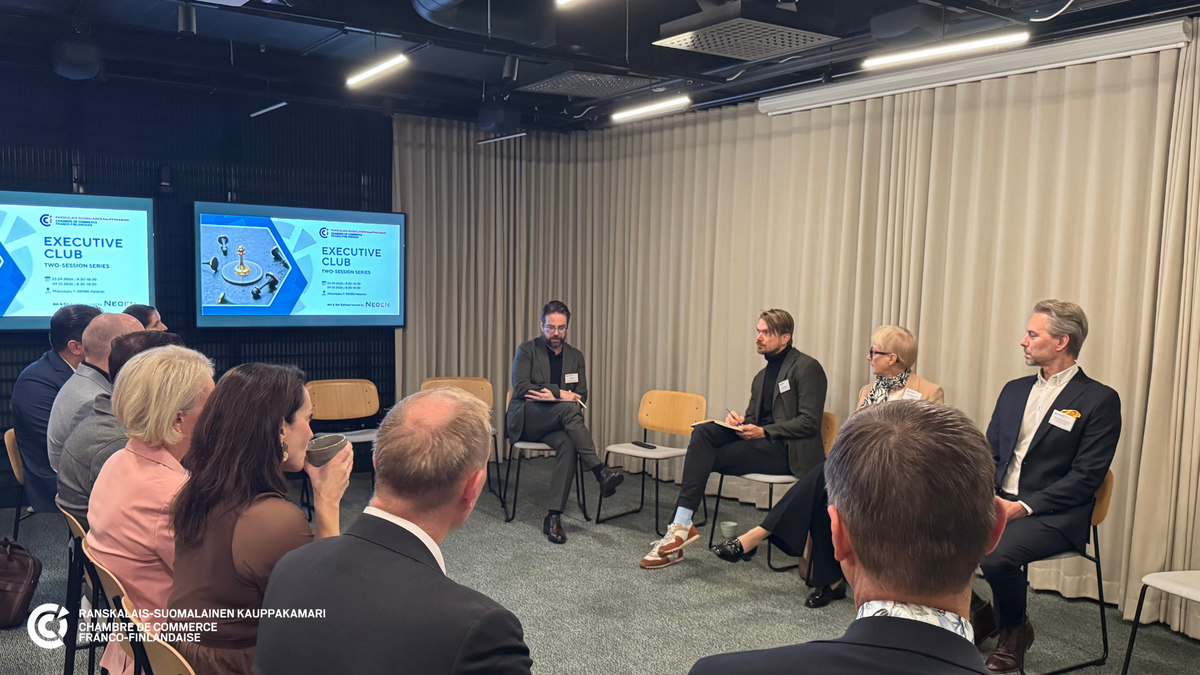
The latest Executive Club of the French-Finnish Chamber of Commerce brought together senior executives and foresight experts to explore a fundamental question: how can leaders move beyond traditional forecasting and better prepare their organisations for multiple possible futures?
The discussion featured valuable contributions from Antti-Jussi Tahvanainen (Head of Strategic Foresight at VTT), Johannes Koponen (Founder & CEO of AI-Ennakointi Oy), and Marjo Liukkonen-Lazaro (Managing Director & Country Head Finland at BNP Paribas); bringing together research, foresight expertise and a concrete business perspective.
From forecasting to foresight
One of the central messages of the discussion was that strategic foresight is not about predicting the future. It is about developing the ability to identify signals, challenge assumptions and prepare organisations to respond to different possible developments. Foresight can support strategic planning by helping leaders make better-informed decisions today, particularly when operating in increasingly uncertain and rapidly changing environments.
What should leaders be watching?
A key discussion focused on the importance of identifying relevant signals. Rather than simply looking forward, organisations can also work backwards from their strategic priorities and ask: which signals would indicate that our environment is beginning to change?
Foresight as a continuous strategic discipline
Strategic foresight should not be used to confirm existing assumptions or established ways of working. Its value lies precisely in challenging them.
The discussion highlighted the importance of bold decision-making and risk-taking, as well as the need to create organisational structures that allow companies to react and adapt quickly.
The human factor
Short-term thinking, the preference for immediate results and our natural cognitive biases can make it difficult to engage seriously with uncertainty. Strategic foresight provides a framework to challenge these tendencies and encourage leaders to consider alternative perspectives and possible futures.
The ability to build different interpretations of what may lie ahead - and to pivot when circumstances change - therefore becomes a key organisational capability.
From foresight to collective action
Strategic foresight ultimately requires greater awareness and transparency around our assumptions: not simply asking “What will happen?”, but rather “What could happen, what does it mean for us, and what can we do about it?”
This first session laid the foundations for the next Executive Club meeting, which will move from understanding strategic foresight to putting it into practice through a hands-on workshop.
Thank you to our member Neoen for generously hosting this event.